
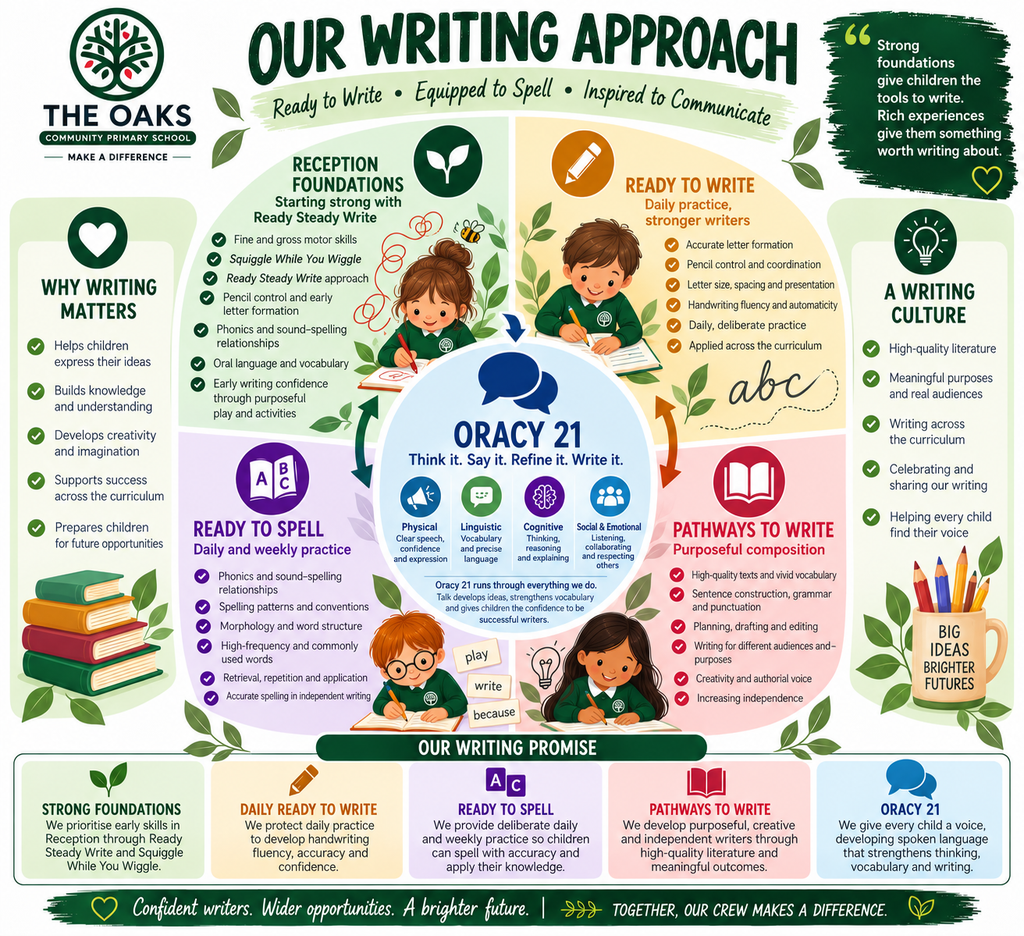
Our Writing Approach at The Oaks Community Primary School
Ready to Write. Equipped to Spell. Inspired to Communicate.
At The Oaks Community Primary School, we believe that every child deserves the confidence, knowledge and skills to become a successful writer.
Writing is one of the four core drivers of our curriculum, alongside reading, mathematics and oracy. It enables children to express their ideas, communicate knowledge, develop creativity and make sense of the world around them.
Our ambition is for every child to become a fluent, accurate, confident and increasingly independent writer who understands not only how to write, but why writing matters.
We recognise that successful writing is complex. Children must bring together handwriting, spelling, vocabulary, sentence construction, grammar and composition, while considering their audience and purpose.
Our approach therefore places particular importance on strong foundational skills, explicit teaching, deliberate practice and purposeful opportunities to write.
We want the essential skills of handwriting and spelling to become increasingly automatic, freeing children to concentrate on developing ideas, constructing sentences and communicating effectively.
Our writing curriculum brings together five connected elements:
- Reception Foundational Skills: Building strong foundations through Squiggle While You Wiggle, Ready Steady Write and Read Write Inc. Phonics, developing physical readiness, early language, transcription and composition.
- Ready to Write: Protecting daily practice to develop accurate, fluent and increasingly automatic handwriting.
- Ready to Spell: Using deliberate daily and weekly practice to secure spelling knowledge through teaching, retrieval, repetition and application.
- Pathways to Write: Developing purposeful, creative and increasingly independent writers through high-quality literature and carefully sequenced teaching.
- Oracy 21: Strengthening spoken language, vocabulary, reasoning and communication, giving every child the confidence to express their ideas.
Together, these elements provide a coherent approach to developing successful writers from Reception through to Year 6.
1. Strong Foundations: Starting in Reception
Every Successful Writer Needs Strong Foundations
At The Oaks, we believe that successful writing begins long before children are expected to produce extended pieces of written work.
Our Reception curriculum deliberately prioritises the physical, linguistic and early literacy foundations that children need to become confident and capable writers.
We recognise that children enter school with different experiences, strengths and starting points. Our approach therefore provides carefully planned opportunities to develop the essential skills of movement, coordination, language, phonics and early composition.
Through Ready Steady Write, Squiggle While You Wiggle and Read Write Inc. Phonics, we provide a connected approach to early writing development, combining purposeful experiences, explicit teaching and regular opportunities for practice.
Squiggle While You Wiggle: Movement Before Marks
We recognise that handwriting begins with physical development.
Our use of Squiggle While You Wiggle helps children develop the gross motor movements, coordination and physical control that provide important foundations for handwriting.
Through energetic, purposeful movement activities, children explore large-scale patterns and movements before transferring these skills into increasingly controlled mark-making.
This approach supports the development of:
- Gross motor coordination: Developing whole-body movement, balance and control.
- Shoulder and arm strength: Strengthening the physical foundations needed for controlled writing movements.
- Bilateral coordination: Developing the ability to coordinate both sides of the body.
- Fine motor readiness: Supporting the transition from large movements to smaller, more precise actions.
- Pre-writing patterns: Exploring lines, circles and other movements that contribute to letter formation.
- Confidence and enjoyment: Making early writing development active, engaging and accessible.
By providing opportunities to develop movement before expecting precise pencil control, we aim to ensure that children are physically prepared for the demands of handwriting.
Ready Steady Write: Developing Early Writers
Our Ready Steady Write approach supports the development of early writing through high-quality texts, purposeful language experiences and carefully sequenced opportunities for composition.
We believe that children need rich experiences of stories, vocabulary and spoken language to develop ideas worth communicating.
Through Ready Steady Write, children are encouraged to:
- Engage with high-quality stories and meaningful texts.
- Develop vocabulary through discussion, storytelling and shared experiences.
- Rehearse ideas and sentences orally before writing.
- Explore characters, settings and events.
- Understand that writing communicates meaning and has a purpose.
- Develop confidence in moving from spoken language to written words and sentences.
- Begin composing and recording ideas with increasing independence.
Our approach places particular emphasis on oral rehearsal, modelling and purposeful writing opportunities, helping children make connections between what they say, what they think and what they write.
Ready Steady Write provides an important foundation for the progression into Pathways to Write as children move through school.
Phonics and Early Transcription: Read Write Inc.
Alongside physical development and early composition, children develop the phonics knowledge needed to begin writing independently.
Through Read Write Inc. Phonics, children learn to recognise sounds, understand sound–letter relationships and use their developing knowledge to segment and spell words.
This supports children in moving from early mark-making to writing recognisable words, captions and simple sentences.
We recognise that phonics, handwriting and composition are interconnected but distinct aspects of writing development. Each requires explicit teaching and opportunities for practice.
Developing Language and Oracy from the Beginning
Spoken language is central to our Reception writing approach.
Children are provided with purposeful opportunities to listen, talk, describe, explain, retell stories and rehearse sentences.
Through adult modelling, high-quality interactions and carefully planned language experiences, children develop the vocabulary and sentence structures that underpin successful writing.
This provides the earliest foundations for our whole-school Oracy 21 approach, where children learn to think, speak, listen and communicate with increasing confidence.
We want children to understand from the very beginning that their ideas matter and that writing is a powerful way to share them.
Bringing the Foundations Together
Our Reception approach brings together three complementary elements:
Squiggle While You Wiggle — Developing the Physical Foundations
Movement, coordination, motor control and early mark-making.
Ready Steady Write — Developing Language and Composition
Stories, vocabulary, oral rehearsal, imagination and purposeful early writing.
Read Write Inc. Phonics — Developing Early Transcription
Sound–letter knowledge, segmenting, spelling and the skills needed to record words and sentences.
Together, these approaches support children’s progression from movement and mark-making to increasingly confident, accurate and meaningful writing.
Our commitment: We give every child the strongest possible start by developing the physical skills, language, phonics knowledge and confidence needed to become a successful writer.
2. Ready to Write: Daily Practice, Stronger Writers
Developing Automaticity Through Deliberate Practice
At The Oaks, we recognise that handwriting is a fundamental component of successful writing.
Our Ready to Write approach provides protected daily opportunities for children to develop, practise and secure the essential skills of handwriting.
We understand that when children have to devote significant attention to forming letters, remembering movements or organising their writing on a page, they have less capacity available for generating ideas and composing sentences.
By explicitly teaching handwriting and providing frequent, purposeful practice, we aim to develop increasing accuracy, fluency and automaticity.
Our Ready to Write approach focuses on:
- Accurate letter formation: Developing correct and consistent formation through explicit modelling and practice.
- Pencil control and coordination: Strengthening precision, control and confidence.
- Letter size, orientation and spacing: Supporting legibility, consistency and effective presentation.
- Handwriting fluency: Increasing the ease and efficiency with which children form letters and write words.
- Automaticity: Helping essential transcription skills become increasingly secure and effortless.
- Application and independence: Encouraging children to maintain handwriting expectations across different subjects and writing contexts.
Daily practice is carefully focused, with opportunities for repetition, feedback and improvement.
We recognise that little and often, when carefully planned and explicitly taught, can make a significant difference.
Ready to Write is not simply about presentation. It is about equipping children with the fluency and confidence needed to communicate their ideas without unnecessary barriers.
Our commitment: We protect time every day to develop the handwriting accuracy and fluency that support successful, independent writing.
3. Ready to Spell: Learning, Remembering and Applying
Deliberate Daily and Weekly Practice
Spelling is an essential part of effective written communication.
At The Oaks, our Ready to Spell approach ensures that spelling is taught explicitly, practised deliberately and revisited regularly.
We recognise that accurate spelling requires more than learning lists of words. Children need secure phonics knowledge, an understanding of spelling patterns and conventions, knowledge of word structure and repeated opportunities to retrieve and apply what they have learned.
Our approach combines daily spelling practice with planned weekly teaching, retrieval and review, helping children develop increasingly secure and automatic spelling knowledge.
Ready to Spell focuses on:
Phonics and Sound–Spelling Relationships
Children build upon their phonics knowledge, understanding how sounds are represented through letters and combinations of letters.
Spelling Patterns and Conventions
Children explore common spelling patterns and conventions, learning to recognise and apply them accurately.
Morphology and Word Structure
Children develop an understanding of root words, prefixes and suffixes, recognising how words are constructed and how meaning influences spelling.
High-Frequency and Commonly Used Words
Regular practice helps children develop automatic recognition and accurate spelling of words they frequently need in their writing.
Retrieval and Repetition
Previously taught spelling knowledge is revisited through carefully planned opportunities for recall, practice and application.
Applying Spelling in Context
Children are supported to transfer their spelling knowledge into sentences, independent writing and work across the curriculum.
Our approach recognises that spelling knowledge must be secured over time. We therefore place importance on regular review, feedback and opportunities to correct misconceptions.
The aim is not simply for children to spell words correctly during a spelling activity, but to use their knowledge accurately and independently when writing.
Our commitment: We make spelling a deliberate and consistent priority, ensuring that children have the knowledge, practice and confidence to write accurately.
4. Pathways to Write: Writing with Purpose
From Strong Foundations to Confident Composition
While handwriting and spelling provide essential tools for writing, children also need the knowledge, language and creativity to communicate effectively.
At The Oaks, Pathways to Write supports our approach to developing confident and purposeful writers through high-quality literature, carefully sequenced teaching and meaningful writing outcomes.
We believe that children write most successfully when they understand their purpose, know their audience and have the vocabulary, knowledge and skills needed to communicate their ideas.
Through Pathways to Write, children develop:
- Rich vocabulary: Exploring, understanding and applying increasingly precise and ambitious language.
- Sentence construction: Learning how to build, combine, extend and manipulate sentences effectively.
- Grammar and punctuation: Developing secure knowledge and applying grammatical conventions in context.
- Composition: Planning, organising and developing ideas into coherent and purposeful writing.
- Audience and purpose: Understanding how language, structure and style change according to the intended reader and reason for writing.
- Editing and improvement: Reviewing, refining and improving writing to increase clarity, accuracy and impact.
- Independence: Applying taught knowledge and skills with increasing confidence and reduced reliance on adult support.
High-quality texts provide models of effective writing and opportunities to explore how authors use language to communicate meaning.
Through explicit modelling, guided practice, discussion and carefully planned opportunities for independent application, children develop the confidence to make increasingly informed choices as writers.
Our aim is to ensure that children do not simply complete writing tasks, but understand how to craft writing that communicates successfully.
Our commitment: We develop writers who can communicate with accuracy, creativity, clarity and purpose.
5. Oracy 21: Think It, Say It, Refine It, Write It
Giving Every Child a Voice
At The Oaks, oracy is one of the four core drivers of our curriculum, alongside reading, writing and mathematics.
Through our Oracy 21 approach, we deliberately prioritise spoken language, recognising that confident communication, purposeful discussion and the ability to articulate ideas are essential to successful learning.
We believe that children need opportunities to think, talk, rehearse and refine their ideas before they are expected to communicate them effectively in writing.
Oracy is not simply an additional activity. It is deliberately taught, modelled and developed throughout the school day.
Our approach draws upon four interconnected dimensions of oracy:
Physical
Developing clear speech, appropriate volume, pace, expression and confident presentation.
Linguistic
Building vocabulary, choosing precise language, developing grammatical accuracy and constructing increasingly sophisticated spoken sentences.
Cognitive
Organising ideas, explaining thinking, reasoning, questioning, justifying opinions and building on the contributions of others.
Social and Emotional
Listening actively, taking turns, responding respectfully, considering different perspectives and developing confidence in communicating with others.
Oracy as a Foundation for Writing
Purposeful talk plays a particularly important role in developing successful writers.
Through our Oracy 21 approach, children are encouraged to:
- Rehearse sentences orally before writing.
- Explore and apply new and ambitious vocabulary.
- Organise their ideas through structured discussion.
- Explain, justify and refine their thinking.
- Listen to alternative ideas and build upon them.
- Develop increasingly accurate and sophisticated spoken sentences.
- Use discussion and feedback to improve written composition.
Teachers explicitly model effective spoken language and provide opportunities for paired talk, storytelling, explanation, presentation, discussion and debate.
We recognise that spoken language development is particularly important for children who may have gaps in vocabulary, language knowledge or confidence.
By prioritising oracy, we aim to strengthen not only writing, but also reading comprehension, mathematical reasoning and learning across the wider curriculum.
Oracy Across the Curriculum
Oracy 21 is embedded across school life.
Children are encouraged to explain mathematical reasoning, discuss scientific findings, interpret historical evidence, explore geographical concepts and communicate their understanding through purposeful dialogue.
Our aim is for every child to develop the language, confidence and communication skills needed to participate fully in learning and beyond.
Our commitment: We give every child a voice, teaching them to speak confidently, listen carefully, think deeply and communicate with purpose.
Think It. Say It. Refine It. Write It.
6. Writing Across the Curriculum: Meaningful Connections
Writing is an essential tool for thinking, learning and communicating knowledge.
At The Oaks, we recognise that the wider curriculum provides valuable opportunities for children to apply and strengthen their writing skills.
Our approach deliberately connects writing with the knowledge, vocabulary and experiences children encounter across different subjects.
For example:
- History: Explaining events, constructing accounts, interpreting evidence and communicating understanding of change.
- Geography: Describing places, explaining processes and presenting geographical knowledge.
- Science: Recording observations, communicating findings and explaining scientific understanding.
- Religious Education and PSHE: Reflecting on ideas, exploring perspectives and communicating thoughtful responses.
We recognise that writing must be purposeful and appropriate to the subject being taught.
Our aim is not simply to increase the quantity of writing children produce. It is to ensure that writing helps children organise their thinking, deepen their understanding and communicate knowledge effectively.
We also recognise that the knowledge and vocabulary gained through the wider curriculum strengthen children’s ability to write with confidence and authority.
Our commitment: We create meaningful opportunities for children to apply writing skills while deepening their knowledge and understanding of the world.
7. Knowing Our Writers: Assessment and Responsive Teaching
We recognise that children develop writing skills at different rates and that effective teaching must respond to their individual needs.
Our approach to assessment helps teachers understand what children know, what they can do and which skills require further teaching or practice.
We consider development across the different components of writing, including:
- Physical foundations and handwriting control.
- Letter formation, fluency and automaticity.
- Phonics, spelling knowledge and accuracy.
- Vocabulary and spoken language.
- Sentence construction, grammar and punctuation.
- Composition, organisation and audience awareness.
- Independence, confidence and application.
Through classroom observation, review of written work, regular practice and ongoing assessment, teachers identify strengths and gaps in learning.
Where children require additional support, we prioritise the essential knowledge and skills that will make the greatest difference.
We recognise that some children need more opportunities to practise foundational skills, while others need support in developing language, constructing sentences or organising extended writing.
Our focus is on ensuring that assessment leads to purposeful teaching, timely support and improved outcomes.
Our commitment: We identify barriers early, respond deliberately and provide the teaching and practice every child needs to become a successful writer.
Our Writing Promise
At The Oaks Community Primary School, we believe that every child can become a confident, accurate and purposeful writer.
We are committed to building strong foundations, protecting time for deliberate practice and creating meaningful opportunities for children to communicate their ideas.
Our writing promise is built upon five connected priorities:
1. Strong Foundations from Reception
We prioritise the earliest building blocks of writing through Squiggle While You Wiggle, Ready Steady Write and Read Write Inc. Phonics.
We develop physical readiness, motor control, vocabulary, spoken language, phonics and early composition so that children are increasingly confident and prepared for the demands of writing.
We recognise that strong foundations are not an optional extra. They are essential to children’s future success.
2. Ready to Write — Every Day
We protect daily handwriting practice to develop accuracy, fluency and automaticity.
3. Ready to Spell — Learn, Retrieve, Apply
We provide deliberate daily and weekly spelling practice to secure knowledge, strengthen retention and develop accuracy.
4. Pathways to Write — Purposeful Composition
We use high-quality literature, explicit teaching and meaningful writing opportunities to develop confident, creative and independent writers.
5. Oracy 21 — Every Child Has a Voice
We teach children to speak, listen, explain, reason and rehearse language, recognising that strong spoken communication supports successful writing.
Together, these priorities ensure that writing is taught systematically, practised deliberately and applied meaningfully.
We want our children to leave The Oaks with the knowledge, confidence and independence to communicate effectively in school and throughout their lives.
Ready to Write. Equipped to Spell. Inspired to Communicate.
Strong foundations give children the tools to write. Rich experiences give them something worth writing about. Oracy gives them the confidence to find their voice.